Rocks and Minerals Vocabulary for Kids
Rocks and Minerals Vocabulary in English for Kids: Words and Activities introduces names, describing words, and tasks for exploring natural materials in English. Children begin with contrasts such as rough and smooth, then learn rock names such as granite, sandstone, and marble. Real samples or photographs connect each word to an object. The goal is to help your child observe, compare, ask questions, and report findings—not memorise a geology book. These skills build accurate, age-appropriate English and science.
Core Words and Phrases
When using Rocks and Minerals Vocabulary in English for Kids: Words and Activities, teach small groups of related words. Begin with objects and properties before introducing unfamiliar rock and mineral names. Let your child hold a safe sample, name it, and use the word in a short sentence.
Build phrases before long descriptions: “a smooth pebble,” “a shiny mineral,” or “a dark rock with pale spots.” Then model a full pattern: “This rock is rough, heavy, and grey.” Your child can replace one word at a time instead of inventing a whole sentence.
How Rocks, Minerals, Crystals, Gems, and Fossils Differ
These words are related but have different meanings. A rock is natural solid material made from one or more minerals. A mineral has its own composition and ordered internal structure. Children need not master the scientific detail at first, but they should distinguish rocks from minerals.
A crystal can be a mineral, but not every mineral sample displays a crystal shape. A fossil may occur inside rock, yet it is not another name for rock. Use the table to sort pictures, labels, or safe samples, then ask your child to explain each choice.
Examples in Everyday English
For Rocks and Minerals Vocabulary in English for Kids: Words and Activities, sentences matter as much as labels. Start with visible or touchable properties. Move from naming to comparing, then give a reason. This sequence builds language without turning practice into a test.
- “This is a small piece of granite.”
- “The pebble feels smooth and cool.”
- “I can see shiny grains in the rock.”
- “This sample is heavier than that one.”
- “The sandstone has visible layers.”
- “I think this is quartz because it looks glassy.”
Keep the exchange moving with questions: “What do you notice?”, “How do the samples differ?”, and “Which word describes the surface?” LearnLink tutors can model a sentence, let the child copy its pattern, and change one detail. The same home routine takes five minutes.
Activities for Different Ages
School-age kids: Choose three safe, large samples or photographs. Ask your child to sort them by rough and smooth, dark and pale, or big and small. Say each contrast aloud. Finish with one repeated frame: “This rock is smooth.” Avoid tiny pieces that could be swallowed.
School-age kids: Make a collection card for each sample. Add its name, colour, texture, and one sentence. Compare two cards using “both,” “but,” and “than”: “Both rocks are dark, but basalt is smoother.” If the name is unknown, write “unknown rock” instead of guessing.
School-age kids: After checking a reliable reference, group samples as igneous, sedimentary, or metamorphic. Your child can write a claim with evidence: “This may be sedimentary because it has layers.” Keep “may” because appearance alone does not always identify a rock.
Practice Ideas That Need Little Preparation
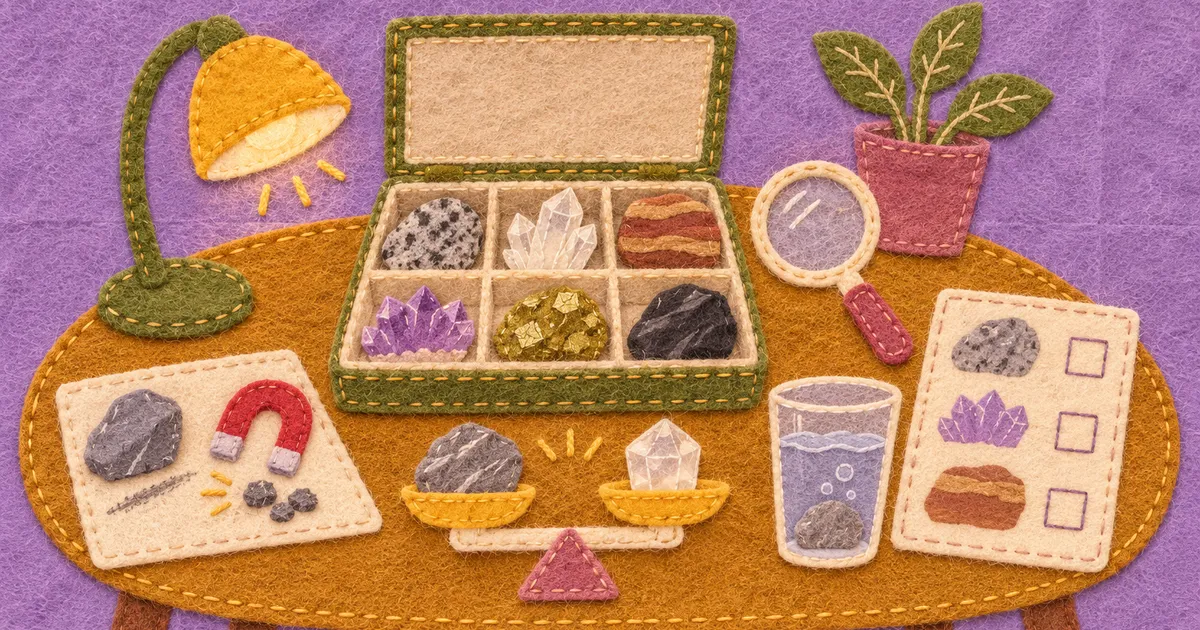
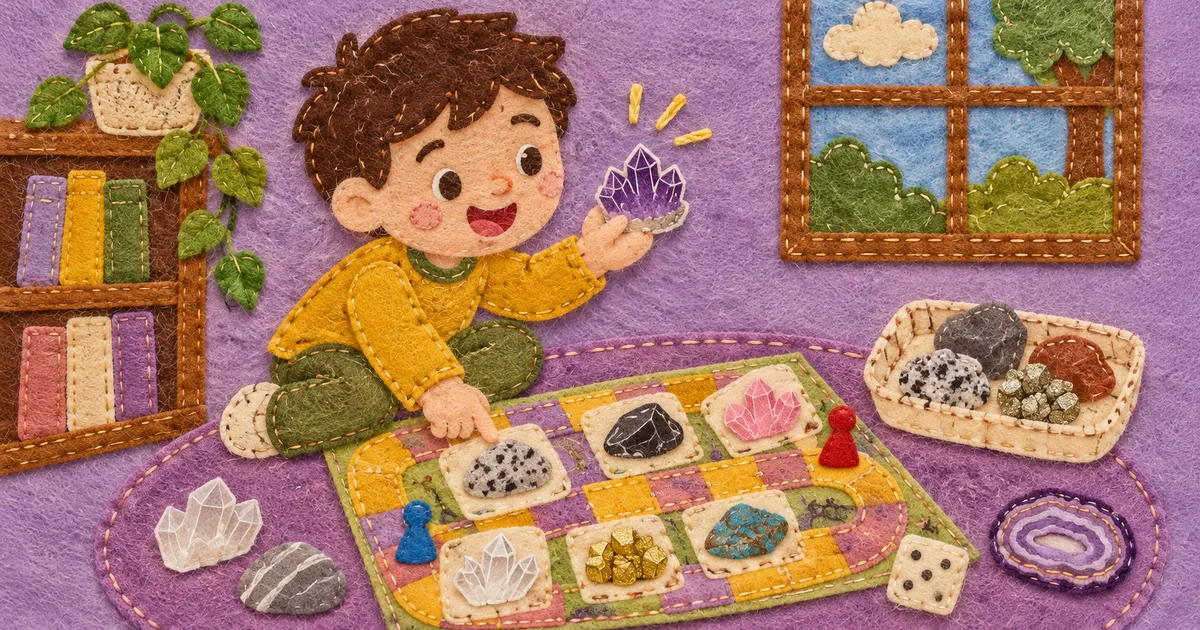
Keep Rocks and Minerals Vocabulary in English for Kids: Words and Activities active by reusing words in new tasks. Try word-and-picture memory cards, a timed description, or a mystery bag with safe, familiar stones. The listener identifies each sample from its properties.
Rock Detective Challenge
Place three safe samples on a table. One person secretly chooses a sample and gives three clues without naming it: “It is pale. It has dark spots. It feels rough.” The other person points to the match and answers in a full sentence. Swap roles, then sharpen the clues.
A walk can become a speaking task without collecting objects. Photograph permitted rocks or describe them in place. Local rules may forbid removing rocks from beaches, parks, or protected land. At home, sort the photographs and record a 30-second English guide to the most interesting sample.
Common Language and Learning Mistakes
Rock and stone overlap in everyday English. Rock is the safer scientific term for material or a studied sample. Stone often means a smaller piece or material used in objects and buildings. Teach both through examples instead of treating them as exact opposites.
- Say “This rock is heavy,” not “This rock has heavy.”
- Say “It is made of minerals” or “It contains quartz.”
- Use “hard” for resistance to scratching, not as another word for heavy.
- Use “shiny” for reflected light and “clear” for material that light can pass through.
- Treat quartz as a material in “This contains quartz,” but count separate pieces as “two quartz crystals.”
Never identify unknown samples by licking, breaking, or making dust. Wash hands after handling a collection, and let an adult manage scratch tests. Observation matters more than a confident guess. “It looks like granite, but we need to check” models sound science and accurate English.
- Sort six rock picture cards into igneous, sedimentary, and metamorphic groups.
- Contrast mineral and rock using two labeled objects and complete sentences.
- Practice pronouncing quartz, granite, marble, and crystal before describing each sample.
- Correct mix-ups by asking, “Is it a rock or a mineral?”
- Review five vocabulary words with a matching game, then reuse them aloud.
When a word has several meanings or pronunciations, Cambridge Dictionary is a useful check before turning it into child-friendly examples.
Frequently Asked Questions
These answers offer families a manageable, safe starting point for rock and mineral practice.
Which Rock and Mineral Words Should My Child Learn First?
Start with rock, stone, mineral, crystal, smooth, rough, hard, soft, shiny, dark, and pale. These words suit varied samples and photographs. Add granite, sandstone, marble, and quartz after your child describes visible properties. Rocks and Minerals Vocabulary in English for Kids: Words and Activities should grow in small sets, with each new word used in a phrase and sentence.
Can a Multilingual Child Use Another Language During the Activity?
Yes. Another language can connect a new English word with existing knowledge. Give the English label, demonstrate its meaning, and allow a brief home-language comparison. Then return to an English frame such as “The rock is rough.” Testing every word through translation is unnecessary.
How Can My Child Collect Rocks Safely?
Follow local rules and collect only where removal is allowed. Choose clean pieces without sharp edges, and keep small samples away from young children. Never taste rocks, breathe dust, or break unknown material. Wash hands after handling samples. Use photographs when a rock must stay in place or cannot be handled safely.
How Often Should We Practise This Vocabulary?
Short practice two or three times across a week is more manageable than one long session. Reuse five or six words through sorting samples, describing a photograph, playing a guessing game, and labelling a collection card. Once your child speaks without a model, add a few terms while retaining earlier words.
Start today with six words and three safe samples. Ask your child to name each sample, describe one property, and make two complete sentences. Repeat this five-minute routine three times this week, then add two new words when the first six feel easy.
Want to see how these ideas work in a real lesson — try a LearnLink trial lesson.
Stay updated on our latest tips and resources by following us on Instagram LearnLink.